March 7, 2025 · PE+ Resources
Warm-Up and Cool-Down: Why They Matter and Easy Examples
Learn why warm-ups and cool-downs belong in every PE lesson, plus easy routines teachers can use with any class.
Warm-ups and cool-downs are often the first pieces cut when a class is short on time. A better approach is to make them brief and purposeful. A warm-up helps students shift from sitting or traveling into the movement patterns of the lesson. A cool-down brings intensity down gradually and gives the class a moment to notice effort, breathing, and what they learned.
What a warm-up should do
An effective warm-up raises body temperature gradually, rehearses the skills that are coming, and establishes the safety expectations for the space. It does not need to be a long stretch sequence or a race. Start with low-intensity travel, add a few dynamic movements, and finish with a short task that looks like the main activity.
- Begin with walking, marching, or easy locomotor travel.
- Move joints through comfortable ranges with reaches, lunges, and arm circles.
- Rehearse a landing, change of direction, throw, or balance that the lesson needs.
- Use a stop cue so students practice control before the game begins.
A five-minute general warm-up
Minute one is quiet travel: walk, skip, or side-shuffle while checking personal space. Minute two adds dynamic reaches and knee lifts. Minute three uses short accelerations between two lines, never at a sprint. Minute four introduces the lesson pattern, such as a soft landing or a ready position. Minute five is a simple partner or small-group challenge. The sequence is predictable enough for young students and easy to adapt for a small room.
Why cool down instead of stopping suddenly?
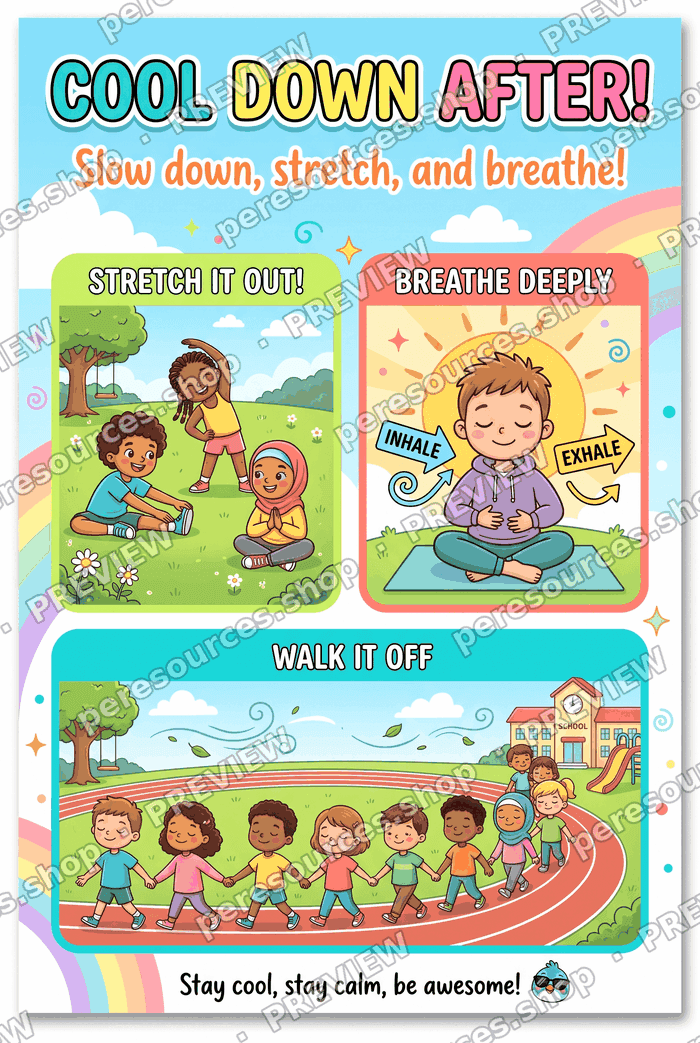
After a lively game or circuit, students may be breathing hard and carrying a lot of excitement. A cool-down gives them a controlled transition. Walk a lap, slow the game to a cooperative task, or use gentle mobility movements. Then ask for one reflection: What helped you keep moving? Which cue will you use next time? The physical slowdown and the question work together to close the learning loop.
Easy cool-down options
- Follow-the-leader walking with slow arm reaches and side bends.
- Partner mirror breathing: one student moves slowly while the other follows.
- A low-intensity equipment return challenge with quiet feet and organized pathways.
- Three balance shapes held for five seconds, followed by a student reflection.
Keep the language flexible
Avoid presenting a warm-up or cool-down as a medical guarantee. Students have different bodies, experiences, and needs, so invite comfortable movement and offer alternatives. Static stretches can be part of a calm finish when they feel appropriate, but they should not be forced or used as a test of flexibility. The goal is readiness, control, and an intentional transition.
A short routine becomes powerful when it appears consistently. Warm-Up Activity Cards can keep the opening fresh without changing the structure, while a visual cue near the meeting spot can remind students what ready and recovered look like. Protect these minutes, make them useful, and your class will gain more than extra movement time: it will gain a dependable way to begin and end well.